


The end of the calendar year has a way of speeding everything up at once. Winter schedules shift, extra duty picks up, cold-and-flu season sends substitute needs soaring, and stipends all seem to arrive in the same week. The work itself doesn’t change…it just hits faster, with more moving parts and far less breathing room.
When employees across different buildings submit time in different ways, those small inconsistencies add up quickly. A missing entry here, a late approval there, and suddenly payroll teams are spending extra hours sorting out details during the tightest stretch of the year. Districts with growing workforces or more frequent payroll cycles feel that acceleration even more.
This is often where districts begin to feel the operational impact of how time is collected.
The Hidden Costs of Manual Time Tracking at Year-End
Most payroll teams can manage variations during a typical month. But during the year-end crunch, inconsistencies quickly turn into extra reconciliation. Districts often see:
- Inaccurate leave balances
Late entries or manual adjustments make balances harder to trust when staff need them most. - Timesheet discrepancies
Different formats and timelines across locations can result in totals that require clarification or correction. - Delays in approvals
Approvers are out or backup workflows aren’t fully in place, slowing payroll during the tightest part of the cycle. - Over/underpayments
Easy to miss during high-volume payroll periods, especially for extra duty or non-standard schedules. - Increased audit risk
Paper forms and ad-hoc adjustments are harder to track cleanly at the busiest point in the year.
These patterns are familiar during year-end payroll. They often start with small differences in how time is captured from one location to the next, and they move quickly when the pace picks up.
District Spotlight: Houston County School District
Houston County School District is one of the largest in Georgia, serving 5,600 employees across 47 locations. The payroll office was accustomed to handling significant volume, but when the district moved to a twice-monthly payroll cycle, the pace changed quickly.
Their existing mix of punch clocks, spreadsheets, and third-party tools meant time was being captured in several different ways across the district. Payroll could keep up — but it required extra verification and manual checks at exactly the time of year when demands were highest.
Rather than continue refining a process that had become too fragmented, Houston County shifted to a districtwide approach using Frontline Time & Attendance. Employees recorded time the same way, pay rules were applied consistently, and data came into payroll clean from the start.
“We knew if we were going to run payroll twice a month, manual entry was no longer sustainable.”
Brian Trent, Houston County Schools
The impact was immediate: more predictable payroll cycles and fewer exceptions to chase down during month-end and year-end.
A Flexible Clock-In Strategy That Supported Everyone
One of the district’s early insights was recognizing that different employee groups needed different ways to record time. What mattered most was consistency in what ultimately reached payroll.
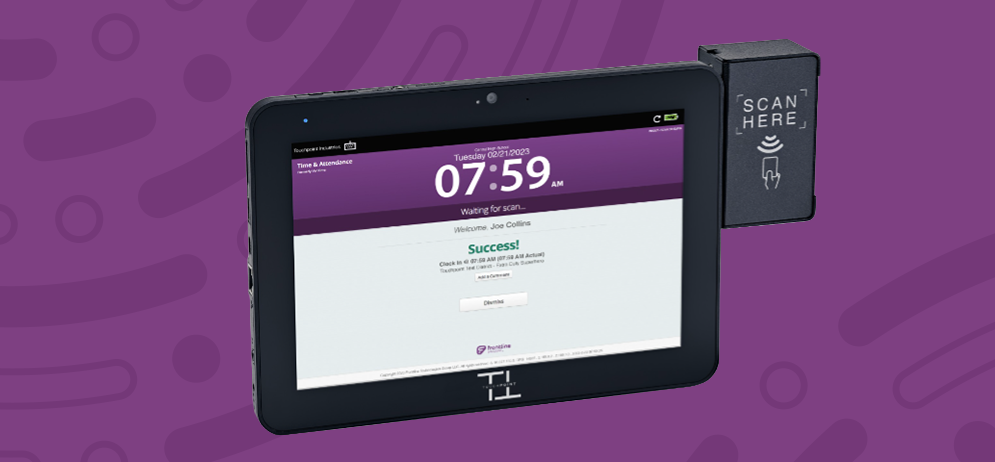
Houston County incorporated Touchpoint SmartClocks into their time-collection mix because:
- Many employees already used proximity badges
- Maintenance and operations staff moved between buildings throughout the day
- A physical device created a uniform experience across sites
Touchpoint’s simple badge scanning feature created a smooth and consistent clock-in experience across all 47 locations and made it easy for staff to tap in and move on with their day.
Behind the scenes, payroll saw the difference: fewer corrections, fewer exceptions, and fewer surprises during the highest-volume months.
“It doesn’t matter where they are in the district — they can clock in and out using the clocks, and it’s a very consistent feel.”


The Results
With a unified approach to time collection supported by Frontline Time & Attendance and Touchpoint SmartClocks, Houston County saw:
- Cleaner, more accurate time records
- Fewer manual entries and less double-checking
- Smoother year-end and biweekly payroll processing
- A consistent experience for employees districtwide
- A system that blended into daily operations with minimal troubleshooting
For a district of their size, consistency became a strategic advantage, especially during the months when timing and accuracy matter most.
What Districts Can Do Now to Prepare for 2026 Payroll Cycles
A few foundational steps can make next December much easier:
1. Standardize Time Collection
Establish consistent, districtwide processes (like badge scanning) so time comes in cleanly regardless of building, role, or schedule.
2. Integrate Absence + Time
Automated alignment between leave data and time worked ensures accuracy without additional manual intervention.
3. Eliminate Paper-Based Workflows
Digital records improve audit readiness, reduce errors, and eliminate delays caused by misplaced or late-submitted documents.
Taking these steps now helps districts reduce payroll errors, strengthen compliance, and enter the busiest periods with confidence.


Erin Shelton
Erin is a writer and member of the award-winning content team at Frontline Education. With experience in education, she is passionate about creating content that helps to support and impact the growth of both students and teachers.